

SBI Mutual Fund IPO: Should I invest?
SBI Mutual Fund IPO must be evaluated differently from prior AMC listings in India. This is not a niche, performance-led equity fund house like HDFC AMC, nor a distribution-agnostic product manufacturer. SBI Mutual Fund represents systemic scale, institutional capital flows, and state-linked trust economics embedded within India’s savings transition.
Table of Contents
India’s capital markets are entering a phase where asset management companies (AMCs) are becoming systemically important financial institutions rather than peripheral market participants. Rising household financialization, sustained equity market participation through SIPs, and the gradual shift from physical to financial savings have structurally altered how long-term capital is accumulated and allocated in the economy.
Within this transformation, SBI Mutual Fund occupies a unique position. As India’s largest asset manager by assets under management, investor base, and ETF presence, SBI Mutual Fund is not merely a beneficiary of industry growth—it is one of the primary conduits through which household and institutional savings are increasingly routed into capital markets.
SBI Mutual Fund IPO: Business Positioning
SBI Mutual Fund is the largest asset manager in India by a significant margin, with FY2025 average AUM of ~₹10.7 lakh crore. This leadership is not the result of superior short-term fund performance alone, but of structural advantages:
- Parentage: Majority ownership by State Bank of India, India’s most trusted financial institution
- Distribution asymmetry: Access to 22,000+ SBI branches and PSU-linked investor ecosystems
- Institutional mandates: ETFs, EPFO, CPSE disinvestment products
- Passive scale: India’s largest ETF platform, where size matters more than alpha
This positioning creates path dependence — the larger SBI MF becomes, the easier it is to attract incremental institutional and passive flows.
SBIMF IPO: Interpreting the Financials
Core Operating Table
| Fiscal Year | Avg. AUM (₹ crore) | Net Flows (₹ crore) | PAT (₹ crore) | Locations (India) |
| FY2023 | 717,161 | 42,021 | 1,331 | 293 |
| FY2024 | 914,365 | 35,075 | 2,063 | 293 |
| FY2025 | 1,072,949 | 73,864 | 2,531 | 293 |
At first glance, these look like “strong growth numbers”. But the critical insight lies in the non-linear relationship between AUM growth and profit growth.
- AUM grew ~17% in FY25
- PAT grew ~23% in FY25
- Net flows more than doubled
This divergence indicates SBI MF has crossed its fixed-cost absorption threshold. Once an AMC reaches sufficient scale, incremental AUM contributes disproportionately to profit because:
- Fund management costs are largely fixed
- Distribution costs are embedded within parent ecosystem
- Technology and compliance scale efficiently
This is why FY2024 marked a profitability inflection, not just a recovery year.
Five-Year View: Separating Cyclical Noise from Structural Trend
Five-Year Operating Data
| Fiscal Year | Avg AUM (₹ lakh crore) | YoY Growth | PAT (₹ crore) | YoY Growth | Investors (million) |
| FY2020 | 3.9 | — | 1,125 | — | 8.5 |
| FY2021 | 4.8 | 23% | 1,186 | 5% | 9.8 |
| FY2022 | 6.3 | 31% | 1,452 | 22% | 11.4 |
| FY2023 | 7.2 | 14% | 1,331 | -8% | 13.0 |
| FY2024 | 9.1 | 27% | 2,063 | 55% | 15.0 |
| FY2025 | 10.7 | 17% | 2,531 | 23% | 17+ |
- FY2023 profit decline was not structural weakness, but market-linked margin compression
- Investor base doubled in five years, even during volatile equity phases
- Post FY2022, SBI MF transitioned from growth-first to efficiency-led growth
Importantly, profit CAGR is lower than AUM CAGR, which tells us SBI MF has consciously accepted lower TER products (ETFs, institutional mandates) to defend market share — a rational long-term trade-off.
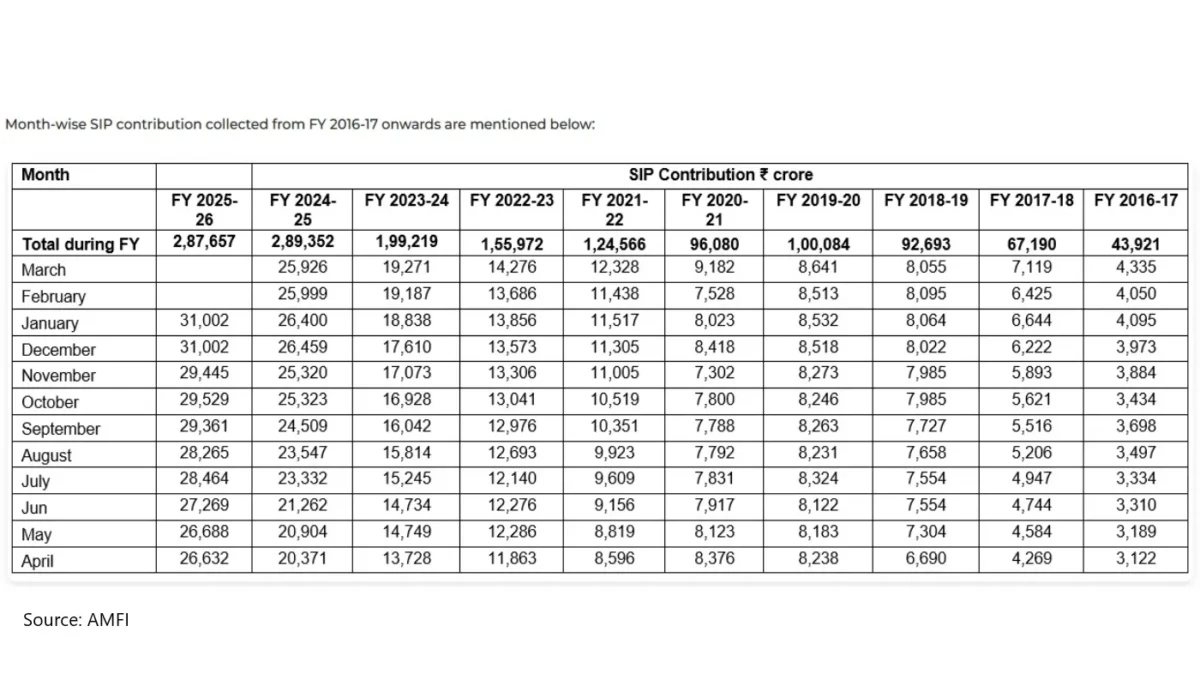
India’s mutual fund industry is entering a scale-dominant phase, similar to the U.S. post-2000s.
Other IPO Analysis
- Tata Capital IPO Details
- Telge Projects Limited IPO Details
- Avanse Financial Services IPO Details
- HDB Financial Services IPO
- Should I invest in the NSDL IPO?
- ICICI Prudential AMC IPO Details
Mutual Fund Industry Market Size India
| Year | Industry AUM (₹ lakh crore) | Growth |
| 2025 | 67 | — |
| 2026 | 78 | 16% |
| 2027 | 92 | 18% |
| 2028 | 108 | 17% |
| 2029 | 122 | 13% |
| 2030 | 135 | 11% |
As the industry grows:
- Alpha differentiation reduces
- Cost sensitivity rises
- Passive products gain share
- Distribution strength dominates fund selection
This structurally favors large AMCs like SBI MF over boutique or mid-sized players.
Why SBI Mutual Fund Is Unlikely to Lose Ground
Market Share Scenario
| Year | Industry AUM | SBI MF Share | SBI MF AUM |
| 2025 | 67 | 16% | 10.7 |
| 2030 | 135 | 16% | 21.6 |
Maintaining market share in a doubling industry implies absolute AUM addition of ~₹11 lakh crore over five years — without aggressive risk-taking.
Given SBI MF’s:
- Government-linked ETF mandates
- Pension and retirement flows
- PSU employee savings base
This assumption is conservative, not optimistic.
SBI Mutual Fund Competitive Comparison: Scale vs Margin Trade-Off
Peer AUM Comparison
| AMC | AUM (₹ lakh crore) |
| SBI MF | 10.7 |
| HDFC AMC | ~7.5 |
| ICICI Pru AMC | ~7.2 |
| Nippon AMC | ~4.5 |
| UTI AMC | ~2.8 |
| ABSL AMC | ~3.0 |
Margin Comparison
| AMC | PAT Margin |
| HDFC AMC | ~35% |
| SBI MF | ~32% |
| Nippon AMC | ~28% |
| UTI AMC | ~18% |
| ABSL AMC | ~22% |
SBI MF trades some margin for strategic control over flows. In a long-duration business, flow control is more valuable than peak margins.
SBIMF IPO Valuation
Valuation Scenarios
| Scenario | P/E | Market Cap |
| Conservative | 30× | ₹75,900 crore |
| Base | 35× | ₹88,600 crore |
| Bull | 40× | ₹1.01 lakh crore |
- At 30–35×, SBI MF offers reasonable entry into a structural compounder
- At 40×+, returns become dependent on perfect execution and continued bull markets
Long-Term Earnings Power (2030 Lens)
If industry AUM reaches ₹130–135 lakh crore and SBI MF maintains share:
- AUM: ₹20–22 lakh crore
- Blended TER (conservative): ~0.45%
- Revenue potential: ₹9,000–10,000 crore
- PAT potential: ₹4,500–5,000 crore
This suggests earnings doubling over 5–6 years, not explosive but highly predictable.
Investment Judgment: Who Should Consider SBIMF IPO?
Suitable For
- Long-term institutional investors
- Pension & insurance portfolios
- Core financial sector allocations
- Investors seeking low volatility compounding
Should I Invest in SBI Mutual Fund IPO
The SBI Mutual Fund IPO is best understood not as a high-growth fintech play, but as financial infrastructure — similar to stock exchanges or clearing corporations.
Its value lies in:
- Predictability of flows
- Embedded trust
- Scale economics
- Alignment with India’s financialization journey
If priced with discipline, SBI Mutual Fund could emerge as one of the most stable long-duration compounding opportunities in Indian capital markets.
SBI Mutual Fund IPO Outlook
The SBI Mutual Fund IPO offers investors exposure to a market-leading, cash-generative asset management franchise positioned at the center of India’s long-term financialization trend. The company combines unmatched scale, institutional trust, and distribution strength, enabling it to capture a disproportionate share of industry growth as India’s mutual fund AUM expands over the next decade.
SBI Mutual Fund should be viewed as a structural compounder, not a performance-led equity AMC. Its investment merit lies in flow durability, operating leverage, and market share stability, rather than short-term alpha generation.