
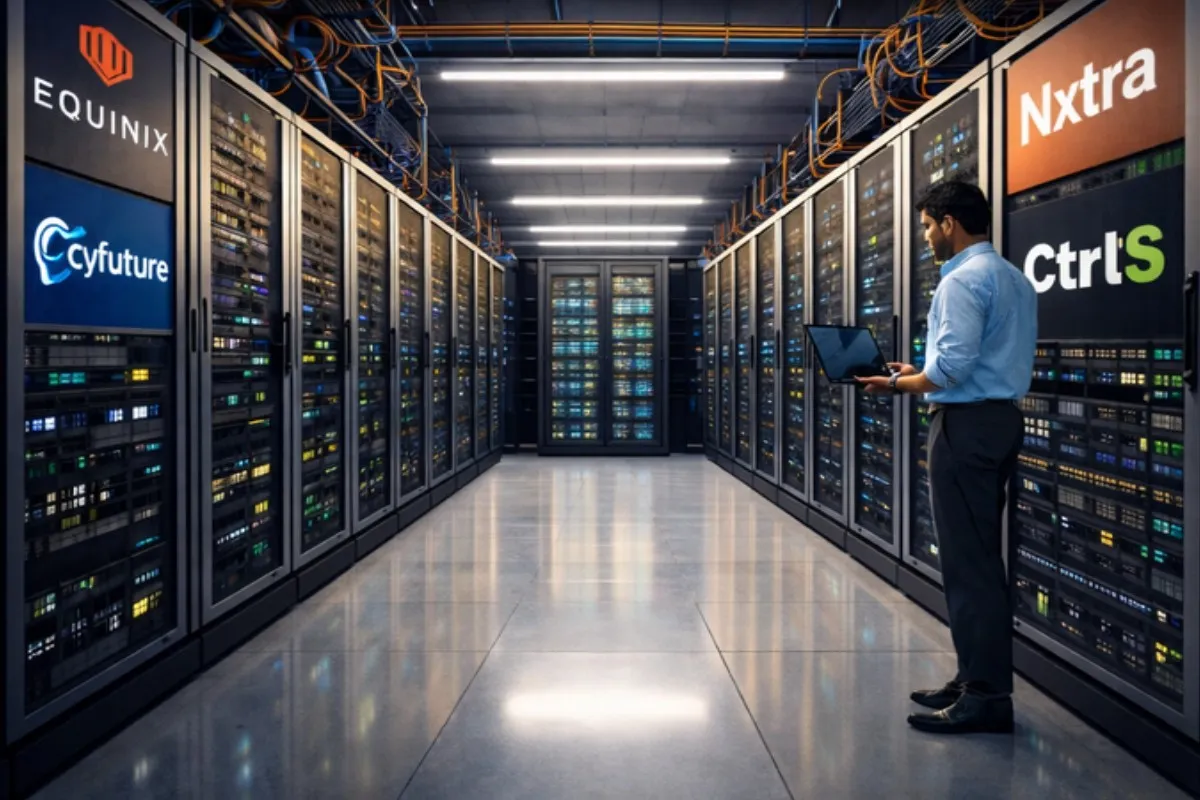
Best Colocation Data Centers in India
India’s digital economy is entering a decisive infrastructure phase. As cloud adoption accelerates, artificial intelligence (AI) workloads scale rapidly, and data localization regulations tighten, colocation data centers have become the backbone of India’s digital, financial, and cloud ecosystems. For enterprises, hyperscalers, and investors alike, the question is no longer whether India’s colocation market will grow, but which platforms will dominate over the next five years.
Table of Contents
What Is a Colocation Data Center?
A colocation data center is a facility where enterprises, cloud providers, and digital platforms place their own servers and IT equipment inside a third-party data center. The operator provides the physical infrastructure—power, cooling, security, connectivity, and redundancy—while customers retain control over their hardware and software.
In India, data center colocation services have become the preferred model for:
- Hyperscalers and SaaS firms seeking rapid, capital-efficient expansion
- BFSI institutions requiring high availability and regulatory compliance
- OTT, gaming, and content platforms demanding low latency and scale
- Enterprises and government agencies focused on data sovereignty
Compared to building captive data centers, colocation allows faster deployment, lower upfront capital expenditure, access to carrier-neutral connectivity, and long-term cost predictability.
India Data Center Colocation Market: Size and Growth
As of H1 2025, India has approximately 1.0–1.3 GW of operational data center capacity (IT load) spread across 120–130 facilities. Mumbai alone accounts for nearly half of this capacity, reflecting its dominance as India’s financial and subsea connectivity hub. Chennai and Delhi NCR together form the second major cluster, while Hyderabad has rapidly emerged as the next hyperscale hotspot.
Looking ahead, 2.9–3.7 GW of additional capacity is planned by 2030, implying a total installed base of 4–5 GW, with upside potential if AI workloads accelerate faster than expected.
From a revenue perspective, the colocation data center market in India was valued at roughly USD 1.2 billion in 2023 and is projected to reach USD 4.5 billion by 2029, translating to a CAGR of 24–25%. Broader data center revenues, including managed services and cloud-adjacent offerings, are growing at high-teens to mid-20s rates.
Demand Drivers and Customer Mix
Several structural drivers are underpinning India’s colocation demand:
- Cloud and AI adoption: GPU-heavy AI training and inference workloads are driving high-density deployments.
- Digital payments and e-commerce: India’s real-time payments and online commerce infrastructure require ultra-reliable, low-latency compute.
- BFSI digitization: Banks, NBFCs, and insurers are migrating core systems to colocation environments.
- Regulatory push: RBI data localization norms and the Digital Personal Data Protection (DPDP) Act encourage in-country data storage.
From a customer mix standpoint, wholesale colocation (large, single-tenant or few-tenant deployments for hyperscalers) dominates capacity additions. However, retail colocation and interconnection-rich campuses—where enterprises, networks, and cloud platforms interconnect—command higher yields and stronger ecosystem lock-in. This distinction is critical when evaluating platforms like Equinix India or Web Werks–Iron Mountain versus hyperscale-first players.
Data Center Related Articles
- Anant Raj Limited: The Best Way to Invest in Data Center Stocks in India
- Data Center in India – Best Data Center Stocks in India to Invest
- NSE listed data center companies in India
- Explore Best Data Center Companies in India
- Opportunities in the Indian Data Center Market
- Fast Growing data center player Nxtra Data Limited Achieved Unicorn status: Learn actionable insights
- Best 5 Top Electronics Companies in India
Colocation Data Centers in India: Geography, Capacity Pipeline, and Absorption
Mumbai and Navi Mumbai remain the anchor markets, accounting for 40–50% of existing and upcoming supply, driven by subsea cable landings and BFSI concentration. Hyderabad, Chennai, and Delhi NCR are the fastest-growing secondary hubs.
Recent market data indicates that absorption is outpacing new supply in prime markets. In H1 2025, India saw over 200 MW of absorption versus about 160 MW of new capacity, keeping vacancy tight and supporting pricing discipline.
By 2030:
- Mumbai and Hyderabad are each expected to add 1,000–1,200 MW
- Chennai, Delhi NCR, Pune, and select tier-2 cities will contribute another 1,000–1,500 MW
This expansion pipeline is where the leading colocation platforms are concentrating their capital.
Economics: Capex, Returns, and Investor Appeal
India enjoys one of the lowest data center build costs globally, at approximately INR 400–430 million per MW (USD 5–5.5 million/MW). Lower land and construction costs, improving power availability, and supportive state policies have made India highly attractive for global capital.
Industry estimates suggest USD 20–30 billion of data center capex will be deployed in India by 2030, with heavy participation from global infrastructure funds such as Blackstone, Brookfield, and ADIA. Most platforms target 65–70% debt funding with 10–12 year tenors.
At stabilized occupancy, EBITDA margins of 40–50% are achievable, supported by long-term contracts and pass-through utility costs. This margin profile explains why several operators are being built with future IPOs, REITs, or InvIT monetization in mind.
Best Colocation Data Centers in India: Leading Platforms
AdaniConneX
AdaniConneX, a JV between Adani Enterprises and EdgeConneX, is one of India’s most aggressive hyperscale-focused colocation platforms. It is targeting over 1,000 MW of capacity by around 2032, backed by Adani’s power, land, and infrastructure ecosystem.
With campuses planned across Chennai, Noida, Navi Mumbai, Hyderabad, Pune, Vizag, and other cities, AdaniConneX positions itself as an integrated data center and technology park platform. Its green power strategy, including renewable energy sourcing, is central to its pitch for hyperscalers.
Five-year outlook: AdaniConneX is likely to emerge as one of India’s top hyperscale landlords, provided it executes its capital-intensive rollout without balance-sheet stress.
Web Werks–Iron Mountain
Web Werks, now part of Iron Mountain Data Centers, represents a more enterprise-centric, interconnection-rich colocation model. With strong footprints in Mumbai, Pune, and Delhi NCR, the platform caters to enterprises, cloud on-ramps, and network providers rather than purely hyperscale tenants.
Iron Mountain’s global customer base and compliance reputation strengthen Web Werks’ appeal to BFSI and regulated industries.
Five-year outlook: Steady, high-quality growth with strong margins, though total MW scale may remain below hyperscale-first peers.
Equinix India (formerly GPX)
Equinix entered India through the acquisition of GPX’s Mumbai facilities and is positioning itself as the country’s premier interconnection hub. Rather than competing on sheer MW, Equinix focuses on ecosystem density—cloud, networks, enterprises, and digital platforms interconnected within the same campus.
Its Mumbai sites act as key cloud on-ramps and peering locations.
Five-year outlook: Equinix will remain a high-margin, strategic platform for enterprises and global customers expanding into India, even if its capacity share is smaller.
Yotta Infrastructure
Backed by the Hiranandani Group, Yotta is building large Tier IV hyperscale campuses in Navi Mumbai and Greater Noida, with a long-term ambition to reach GW-scale capacity. Its integrated approach—combining colocation, sovereign cloud, and AI infrastructure—sets it apart.
Yotta’s state government MoUs and large real estate land banks enable rapid execution.
Five-year outlook: A strong contender in hyperscale and government workloads, with execution and capital access being the key variables.
Reliance (Jio / Digital Connexion)
Reliance’s data center strategy spans internal hyperscale AI infrastructure (Jio) and neutral colocation through Digital Connexion, a JV with Brookfield and Digital Realty. Announcements include a GW-scale AI data center in Jamnagar and a major hyperscale campus in Chennai.
Five-year outlook: Reliance’s unmatched balance sheet and ecosystem give it enormous potential, though third-party colocation monetization will evolve gradually.
Nxtra by Airtel
Nxtra combines core hyperscale facilities with India’s largest edge data center network, spanning over 120 edge sites. Airtel plans to double Nxtra’s capacity to 400+ MW by 2027, including a flagship 200 MW Hyderabad campus.
Its integration with Airtel’s connectivity and enterprise relationships is a key differentiator.
Five-year outlook: Nxtra is well positioned to benefit from both hyperscale and edge demand, especially for low-latency applications.
CtrlS Datacenters
CtrlS is one of India’s most established data center operators, with over 250 MW installed and a roadmap to 650–700 MW by 2030. Its Rated 4 facilities, solar-backed power strategy, and pan-India presence make it a trusted partner for mission-critical workloads.
Five-year outlook: Consistent expansion with strong enterprise and hyperscale demand, potentially leading to IPO or strategic capital raises.
STT GDC India
STT GDC India operates nearly 400 MW across 10 cities, making it one of the country’s largest colocation platforms by scale. Its focus on AI-ready, liquid-cooled campuses positions it well for next-generation workloads.
Five-year outlook: Likely to remain a top-three operator by capacity, with diversified city exposure reducing risk.
Sify Infinit Spaces
Sify is transforming its data center business under Sify Infinit Spaces, with plans to invest USD 5 billion in AI-ready mega campuses and secondary-market inference facilities. A planned IPO could make it India’s first listed pure-play data center company.
Five-year outlook: High upside if execution matches ambition; operational complexity will be the key challenge.
Five-Year Outlook: Who Is Best Positioned?
- Hyperscale leaders: AdaniConneX, STT GDC, Yotta
- Interconnection and enterprise leaders: Equinix India, Web Werks–Iron Mountain
- Telco-backed platforms: Nxtra, Reliance
- AI-first, vertically integrated players: Sify, CtrlS
The “best colocation data center in India” ultimately depends on use case—hyperscale scale, enterprise interconnection, AI density, or edge reach.
Final Words on Colocation Data Centers in India
India’s colocation data center market is entering a phase of scale, consolidation, and specialization. Over the next five years, success will hinge on access to power and land, capital strength, hyperscaler relationships, and the ability to support AI-driven workloads efficiently.
For enterprises, colocation offers flexibility, resilience, and regulatory alignment. For investors, it offers long-duration infrastructure returns with strong growth visibility. And for India’s digital economy, colocation data centers are no longer optional—they are foundational.